
Physics Working Models: Science exhibitions are the highlight of the school calendar and physics working models are generally the stars of the show. These models can be used to demonstrate real physics concepts in motion, as opposed to static charts or posters, and are far more memorable for judges and visitors alike. If you are looking to decide what to build for your next exhibition, this guide covers some of the best physics working models you can make along with tips on choosing the right one for your skill level.
ALSO CHECK: Project Models: Bringing Your Ideas to Life
Why Physics Working Models Stand Out
Science fair judges see dozens of projects in a single day, and they remember the ones that move, light up, or otherwise show a visible reaction. Physics working models do exactly that, bringing abstract formulas to life so you can see, touch, and explain them step by step. Building one also improves your own understanding, since you have to troubleshoot real components rather than simply memorising a concept from a textbook.
1. Simple Electric Motor
A homemade electric motor is one of the most popular physics working models for demonstrating electromagnetism. A battery, a piece of copper wire, and a magnet can demonstrate that electric current can create a magnetic field that produces rotational motion. It is cheap, quick to assemble and clearly shows Faraday’s principles in action. If you need something impressive and don’t have access to advanced tools, it’s a good choice.
2. Hydraulic Lift or Crane
Hydraulic systems are everywhere in real life, from car brakes to construction equipment, and that makes a hydraulic lift model a favourite among students. This project, made of syringes, tubes and water, shows Pascal’s Law: how pressure applied to a confined fluid is transmitted equally in all directions. It is one of the more interesting working physical models for mechanics exhibitions. A small syringe lifting a heavier object always attracts a crowd.
3. Periscope
A classic optics project is the periscope, which shows how light reflects off mirrors placed at specific angles to let you see around corners or over obstacles. It is a great project for beginners as it requires only a few materials: a cardboard tube and two small mirrors – but it really demonstrates the law of reflection well. This model is well-suited if your exhibition topic is light and optics.
4. Generator of Wind Turbine
If your exhibition is on sustainability or renewable energy, a working miniature wind turbine is a good option. A small DC motor with blades attached to it (for example, powering an LED) can be used to demonstrate the conversion of the kinetic energy of the wind into electrical energy. This model combines physics with environmental concern so you can get extra points for relevance and real-world applications.
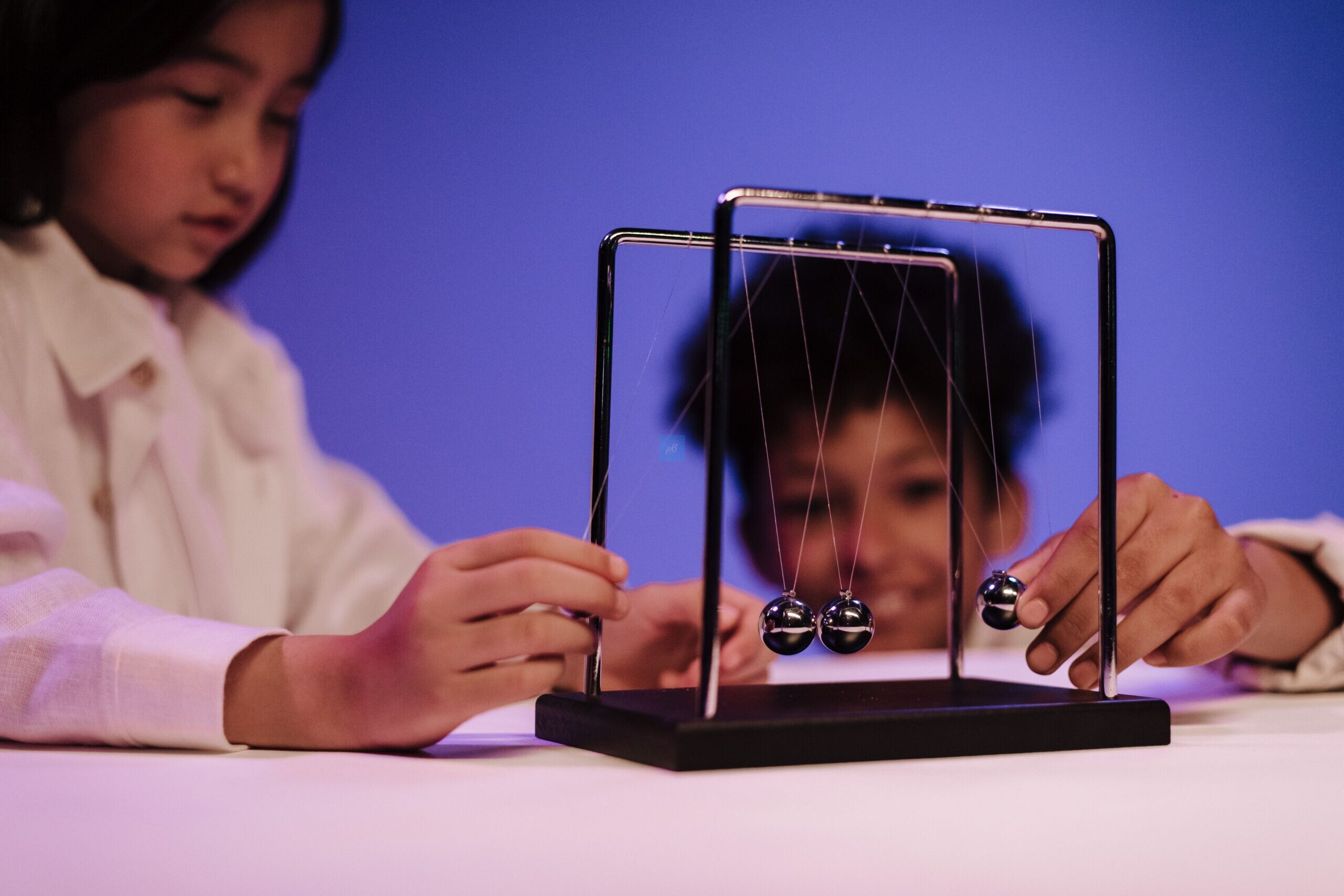
5. Newton’s Cradle
Newton’s Cradle is a visually pleasing demonstration of conservation of momentum and energy. The stationary balls pass energy to the far end of the row, and the ball launches at the other end as one ball swings and hits the row. It is a good intermediate-level project. It is easy to explain, but it takes a little care to build it so the strings are even and the balls are perfectly aligned.
6. Pully System
A multi-pulley system is one of the most useful physical working models, as it well demonstrates how mechanical advantage reduces the force required to lift heavy objects. You can illustrate single, double and compound pulley systems side-by-side and compare the force needed for each system using simple materials such as spools, string and small weights.
Tips for Choosing the Right Model
- Match your skills: Don’t choose something so complex that you don’t understand it all, choose something you can build and explain with confidence.
- Observe a visible movement or effect: models which move or have a visible effect are more interesting than static presentations.
- For safety’s sake: do not run models with open flames, sharp mechanisms, or unstable electrical setups unsupervised.
- Judges often ask follow-up questions, so it’s important to know the physics behind your build just as well as the build itself. Practise your explanation.
Final Thoughts
These physical working models can make your science exhibition experience fun-filled and educational by choosing the right project. That could be anything from a periscope to a hydraulic crane. The important thing is to choose something that you know well enough to be able to describe it clearly. With planning and practice, your project could be an exhibition highlight.
ALSO CHECK: 25 best working models based on physics
Physics Working Models: Frequently Asked Questions (FAQs)
- What is the best working model for beginners?
A good way to begin is a periscope or a simple electric motor. They use few materials and are easy to explain.
- About how long does it take to build one of these?
These projects are, mostly, a matter of hours up to a couple of days to finish, depending on how complicated they are and if you have the materials.
- Do I have to buy expensive materials to make a good model?
No, most of these models employ cheap and easily available supplies such as cardboard, wire, mirrors and syringes.
- What do I need to remember while presenting my model to the judges?
Clearly explain the physics concept behind the model. Be prepared to answer questions about how and why it works.
- Can we construct these models without adult supervision?
Basic models such as the periscope and the pulley system can be safely constructed by yourself, but any model that involves electrical wiring or sharp tools should be done under adult supervision.
Leave a Reply